

How To Evaluate Cleanroom Packaging Suppliers
June 11, 2026
How to Specify ESD Static Shielding Bags for Electronic Components
August 20, 2026
Semiconductor Cleanroom Packaging: Requirements, Materials, and Supplier Considerations
Semiconductor manufacturing leaves very little room for packaging errors. A single contamination event, electrostatic discharge, or handling issue can affect product quality, production yield, and downstream manufacturing processes.
Semiconductor wafers, integrated circuits, photomasks, sensors and precision components are highly sensitive to particles, electrostatic discharge (ESD), moisture, and handling damage. Packaging decisions influence contamination control from production through storage, transportation and final assembly.
For engineers, QA professionals and supplier qualification teams, cleanroom packaging is one part of a broader manufacturing system. Material selection, contamination control, documentation, and process consistency all influence whether packaging performs as expected throughout production, storage and transport.
The sections below outline the technical and operational factors that engineering, quality, and procurement teams typically review when qualifying cleanroom packaging suppliers for semiconductor applications.
Jump to Section:
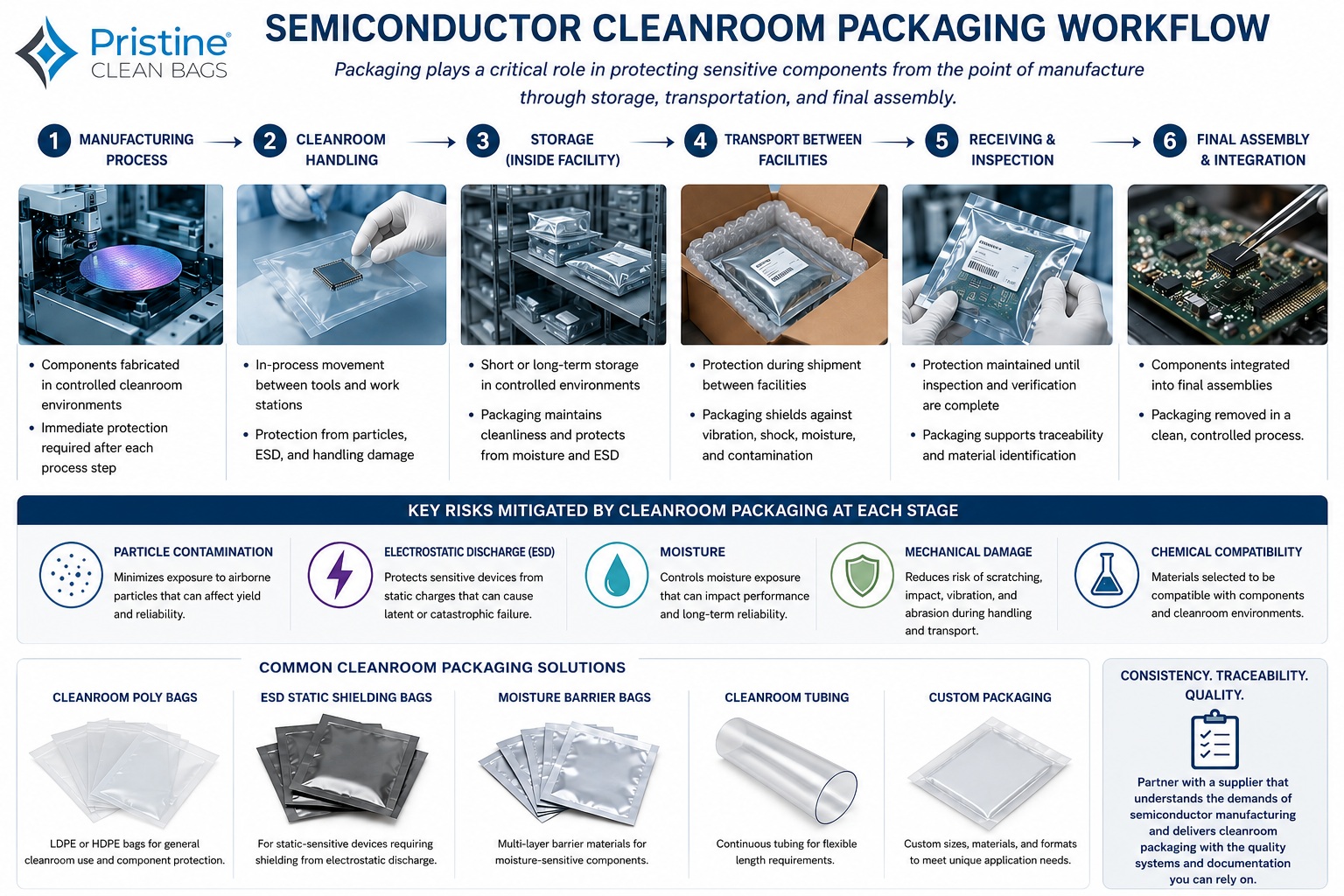
Packaging Requirements Change Throughout the Manufacturing Process
What Semiconductor Packaging Must Protect Against
Material Selection Depends on the Application
Example: Packaging a Precision Wafer Carrier
Questions Engineers Should Ask Packaging Suppliers
Common Packaging Decisions That Create Problems
Supplier Qualification Supports Long-Term Manufacturing Performance
Common Questions
Packaging Requirements Change Throughout the Manufacturing Process
Packaging requirements are not identical throughout production.
The same component may move through several environments before reaching its final destination.
Packaging often supports:
- Movement between manufacturing cells
- Temporary storage inside controlled environments
- Shipment between production facilities
- Long-term storage before assembly
- Protection during incoming inspection
Each stage introduces different risks.
Packaging selected only for transportation may not perform well during repeated handling inside a cleanroom. Likewise, packaging optimized for manufacturing may require additional protection during shipping.
Evaluating the complete workflow often leads to better packaging decisions than focusing on a single process step.
What Semiconductor Packaging Must Protect Against
Effective semiconductor packaging addresses multiple contamination risks simultaneously.
Material Selection Depends on the Application
No single material is appropriate for every semiconductor application.
Selection depends on handling conditions, contamination requirements and product sensitivity.
Material performance should be evaluated alongside thickness, packaging format and application requirements. For a broader comparison, see our guides on cleanroom bag thickness and flat bags vs. tubing.
Why Packaging Consistency Matters
Material selection is only one part of the equation.
Consistency between production batches often has a greater impact on long-term manufacturing performance.
Supplier qualification teams frequently evaluate:
- Material consistency
- Thickness tolerances
- Dimensional accuracy
- Lot traceability
- Documentation control
- Change management
Unexpected variation can introduce unnecessary investigation, additional validation work or production delays.
Consistent packaging simplifies qualification and supports repeatable manufacturing processes.
Example: Packaging a Precision Wafer Carrier
Consider a wafer carrier moving between fabrication, inspection, temporary storage, and final assembly. At each transfer point, packaging is opened, handled, resealed or transported. Each step introduces opportunities for contamination, electrostatic discharge or accidental damage if packaging specifications are not matched to the application. The packaging may be opened, inspected, resealed, transported and stored several times.
Each handling event creates opportunities for:
- Particle exposure
- Electrostatic discharge
- Mechanical damage
- Improper resealing
Selecting the correct material is only part of the solution.
Proper dimensions, appropriate packaging format and consistent manufacturing all contribute to protecting the product throughout the process.
Questions Engineers Should Ask Packaging Suppliers
Selecting a supplier involves more than reviewing product specifications.
Engineering and quality teams often ask:
- Is the packaging manufactured under controlled cleanroom conditions?
- Can material traceability be provided?
- Are thickness and dimensions consistently controlled?
- What documentation accompanies each production lot?
- How are specification changes communicated?
- Is the supplier operating under a documented quality management system?
- Can custom packaging be produced for unique applications?
These questions help reduce qualification risk before production begins.
Common Packaging Decisions That Create Problems
Many packaging issues originate during specification, not manufacturing.
Examples include:
- Selecting oversized bags that allow unnecessary product movement
- Using packaging without considering ESD requirements
- Choosing material based only on cost
- Introducing unnecessary packaging variations across product families
- Assuming all cleanroom packaging materials perform the same
These decisions often create additional work for production and quality teams later.
Supplier Qualification Supports Long-Term Manufacturing Performance
Supplier evaluation should extend beyond individual products.
Organizations frequently review:
- Manufacturing consistency
- Quality management systems
- Documentation practices
- Traceability
- Corrective action procedures
- Capacity to support future production
Pristine Clean Bags® is ISO 9001:2015 certified and manufactures cleanroom packaging under documented quality management processes. This supports manufacturing consistency, traceability and continuous improvement across production.
For semiconductor manufacturers, supplier stability can be just as important as material performance. Many semiconductor manufacturers prefer long-term packaging partners because stable specifications, repeatable quality, and documented change management simplify qualification and reduce production risk over time.
Common Questions
It depends on the application. Material selection should consider contamination control, ESD requirements, moisture sensitivity and handling conditions.
No. Packaging requirements depend on the sensitivity of the product and the organization’s ESD control procedures.
Traceability supports quality investigations, supplier qualification and documentation requirements throughout the manufacturing process.
Depending on the application, buyers may request material specifications, certificates of conformance, lot traceability information and quality documentation.