
How to Specify ESD Static Shielding Bags for Electronic Components
August 20, 2026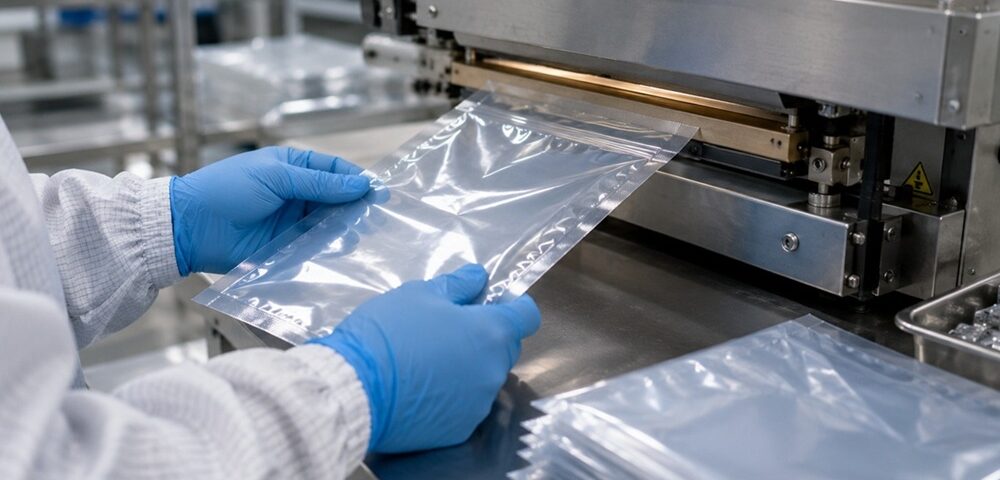
Heat Sealing Cleanroom Bags: Common Seal Problems and How to Prevent Them
A bag seals well on one run, then starts pulling apart on the next. Or the closure looks fine at the packing station but opens when someone lifts the package. Before turning up the heat or ordering a thicker bag, it helps to look at how the seal failed.
Weak seals can come from several sources: the settings, the condition of the sealer, the bag material, or the way the bag sits between the jaws. A fold across the opening needs a different response from film that has melted through.
For cleanroom packaging, these problems also raise a question about the product inside. If the closure opens, can the component still be used, or does it need to be inspected or cleaned again? Your facility’s quality procedures should guide that decision.
Here is what to check when heat sealing cleanroom bags, along with a few ways to prevent the same problem from returning.
Jump to Section:
What Affects the Heat Seal on a Cleanroom Bag?
Common Seal Problems and What to Check First
How to Prevent Problems at the Sealing Station
Why a New Bag May Need Different Settings
How to Check the Finished Seal
What to Share With Your Supplier About a Sealing Problem
Need Help With Your Cleanroom Bag Specifications?
Frequently Asked Questions
What Affects the Heat Seal on a Cleanroom Bag?
A heat sealer joins compatible film surfaces by applying heat and pressure for a set time. That contact time is often called dwell time. The material needs enough heat to form the bond, even contact across the seal, and time for the closure to set before it is put under stress.
On an impulse sealer, the jaws stay closed during a cooling period after the heating cycle. Opening them too soon or pulling on the bag while the seal is still warm can affect the result. Follow the heating and cooling cycle specified for your equipment and material.
It also helps to know exactly what you are sealing. “Poly bag” is a broad description. Check the material, thickness, and construction, including which surfaces are intended to bond. Those details matter when reviewing settings or comparing a new bag with one you have used before.
Common Seal Problems and What to Check First
Start with the failed seal itself. Does it separate along the whole opening, or only at one spot? Is the film wrinkled, stuck to the sealer, or visibly damaged? The pattern can help you decide where to look next.
These are starting points, and more than one cause may be involved. If a weak spot keeps appearing at the same end of the sealing bar, have the equipment checked. If the problem began with a different bag, compare its specification with the previous one. Keep a few affected samples and record the lot number so there is something concrete to review.
If you are unsure whether your bag suits the application, discuss your packaging requirements with Pristine Clean Bags®.
How to Prevent Problems at the Sealing Station
As you load the bag, keep particles, liquid and product residue away from the inside surfaces that will form the seal. Check the opening before placing it between the jaws.
If that area becomes contaminated, follow your facility’s procedure for handling or replacing the bag. Any cleaning method needs to be suitable for both the film and the product being packaged.
Keep the closure area clean
As you load the bag, keep particles, liquid and product residue away from the inside surfaces that will form the seal. Check the opening before placing it between the jaws.
If that area becomes contaminated, follow your facility’s procedure for handling or replacing the bag. Any cleaning method needs to be suitable for both the film and the product being packaged.
Give yourself enough room to close the bag
A bag may fit the component but leave too little film above it for sealing. If an operator has to stretch the opening over the product to reach the jaws, review the bag dimensions.
There should be enough free film to position the opening evenly and make the required seal. The amount depends on the product’s shape and the equipment. Trying to compensate for a tight bag by changing the sealer settings will not solve the fit problem.
Support the contents while the seal forms
Heavy or awkward components should not hang from the bag while it is being sealed. Support them during the cycle and as the package is moved away from the machine. Pay particular attention to any handling that pulls directly on a newly formed closure.
When working with cleanroom poly tubing, check the first end seal before loading the product. Leave enough tubing for the second closure so the final seal is just as easy to position.
Check the equipment as well as the bag
Worn release coverings, damaged support pads, and residue on sealing surfaces can affect the closure. Follow the machine’s maintenance instructions and have worn parts checked by the appropriate person.
Repeated adjustments are worth investigating. If operators keep changing the settings to get an acceptable seal, record when that happens and which bags are affected. That information is more useful than starting each run with a different setting and no record of the previous result.
Why a New Bag May Need Different Settings
A change in material or thickness can change how a bag responds to heat. Folds or extra layers passing through the jaws can also affect sealing. If you are considering a different film gauge, our cleanroom bag thickness guide explains the handling and durability factors to weigh up.
Equipment matters too. An impulse sealer heats during a timed cycle; a constant-heat sealer maintains heated sealing surfaces. Settings cannot simply be copied from one machine to another, even if both machines are used for the same type of bag.
Before using a new bag or sealer in production, confirm that they work together and check the resulting seals. Record the material, machine, settings and results. For a process that has already been validated, involve your quality team before making changes.
How to Check the Finished Seal
Look along the full closure for folds, gaps, damaged film or areas that appear different from the rest. Operators should have clear examples or criteria for deciding which defects require a package to be set aside.
Appearance is only part of the check. A seal can look even without meeting the performance needed for the application. Your quality team can determine which checks are suitable for the bag and product.
Seal strength measures the force needed to separate a test strip containing the seal. It does not, by itself, show that the entire package is free from leaks. A quick pull by hand may reveal an obvious weakness, but it does not replace a defined test where documented results are needed.
Consider what happens after packing as well. If packages will be stored, shipped or handled several times, the checks should reflect those conditions. A closure that survives the trip from the sealer to the bench has not necessarily been assessed for the rest of its use.
What to Share With Your Supplier About a Sealing Problem
You do not need to know the cause before asking about a bag. A few details will help the supplier understand the issue:
- The bag: product code, material, dimensions, thickness and lot number.
- The sealer: make, model, and current settings, including cooling where applicable.
- The problem: photos showing the failed area and a description of when it opens, sticks or distorts.
- The pattern: whether it happens on every bag, occasionally or only after handling.
- Recent changes: a new bag lot, different material, maintenance work or a change in how the product is loaded.
Need Help With Your Cleanroom Bag Specifications?
Considering a switch to Pristine Clean Bags®? Share what you package, your current bag specifications, and the sealing equipment you use. Our team can help you explore materials, sizes and thicknesses suited to your process, including stock and custom options. We can also discuss the product information you need to evaluate our bags before introducing them into production.
Frequently Asked Questions
There is no single temperature that works for every LDPE bag and sealer. The film, equipment, contact time, pressure and cooling all affect the result. Ask for guidance on the actual bag and machine, then confirm the settings through your process checks. The resin’s melting point alone is not a sealing setting.
No. Heat sealing closes the bag; it does not sterilize the contents or the complete package. If the application requires sterility, the packaging must be suitable for the validated sterilization or aseptic process being used.
That depends on the film, the space left for another seal and your facility’s handling procedures. Making a new seal does not restore cleanliness or sterility lost when the bag was opened. Check with your quality team before reusing an opened bag.
Technical Note
This article provides general information about heat sealing cleanroom bags. Sealing requirements vary by material, equipment, and application. Follow the bag and equipment manufacturers’ instructions and your facility’s quality procedures. Confirm suitable sealing conditions through appropriate testing before production use. This guidance does not replace process validation where required.