

Semiconductor Cleanroom Packaging: Requirements, Materials, and Supplier Considerations
July 6, 2026
Heat Sealing Cleanroom Bags: Common Seal Problems and How to Prevent Them
September 9, 2026
How to Specify ESD Static Shielding Bags for Electronic Components
Sensitive electronic components can require several forms of protection before they reach their next production step or final destination. Electrostatic discharge is a major concern, but packaging also has to withstand handling, sealing, storage, transport and the environmental conditions associated with the application.
An ESD packaging specification therefore needs to account for more than a bag labeled “ESD-safe.”
Engineers, QA teams and procurement professionals may need to evaluate shielding performance, electrical resistance, physical construction, dimensions, mechanical properties, cleanroom compatibility and documentation before approving packaging for use.
The sections below cover the main ESD bag specifications to review and the information worth defining before requesting a quote for static shielding bags.
Jump to Section:
Start With the Component and Its ESD Control Requirements
Static Shielding Performance: What Should You Look For?
Surface Resistance and Charge Dissipation
Why Bag Construction Matters
ESD Performance Is Only Part of the Specification
A Practical ESD Bag Specification Review
Moisture: When Static Shielding May Not Be Enough
Cleanroom Applications Add Another Set of Requirements
What to Include in an ESD Packaging RFQ
How to Read an ESD Packaging Data Sheet
Questions to Resolve Before Approving ESD Packaging
Common Questions About ESD Bag Specifications
From Specification to Supplier Quote
Start With the Component and Its ESD Control Requirements
Packaging selection should begin with the device and the ESD control program under which it will be handled.
A component’s sensitivity, handling sequence, storage conditions and transportation requirements can influence the level and type of protection required. Packaging used to move a device within a controlled production area may face different conditions from packaging used for shipment between facilities.
Before specifying a bag, establish:
- What component will be packaged
- Its ESD sensitivity and applicable internal requirements
- Where the package will be opened and sealed
- How many times it may be handled
- Storage and transportation conditions
- Any additional contamination or moisture requirements
These details provide the basis for evaluating the packaging data that follows.
Static Shielding Performance: What Should You Look For?
Static shielding packaging is intended to limit the energy that reaches a sensitive device when an electrostatic discharge occurs outside the package.
Shielding performance is therefore a key specification for components that require this form of protection.
Pristine Clean Bags® ESD static shielding bags have a typical static shielding value of less than 15 nJ when tested according to ANSI/ESD STM11.31 at 12% relative humidity.
The test method matters because a performance number without its test conditions provides limited information. Engineers and quality teams should review the stated value together with the method used to obtain it.
When comparing products, verify:
- The stated shielding performance
- The applicable test method
- Test conditions
- Whether reported values are typical or guaranteed specifications
- Whether the performance aligns with your organization’s ESD control requirements
A technical data sheet should provide enough information for the technical team to evaluate the product within its own ESD control program.
Surface Resistance and Charge Dissipation
Shielding performance is one part of ESD packaging behavior. Surface electrical properties also affect how charge behaves on the package.
Pristine Clean Bags® ESD static shielding bags have a typical outer surface resistivity of ≥1.0 × 10⁴ to <1.0 × 10¹¹ ohms when tested according to ANSI/ESD STM11.11 at 12% relative humidity.
For engineers, the important point is that terms such as “ESD-safe” do not provide enough information by themselves. Measured electrical properties and recognized test methods give technical teams a clearer basis for comparison.
The required resistance characteristics should come from the application’s ESD control requirements instead of a generic packaging category.
Why Bag Construction Matters
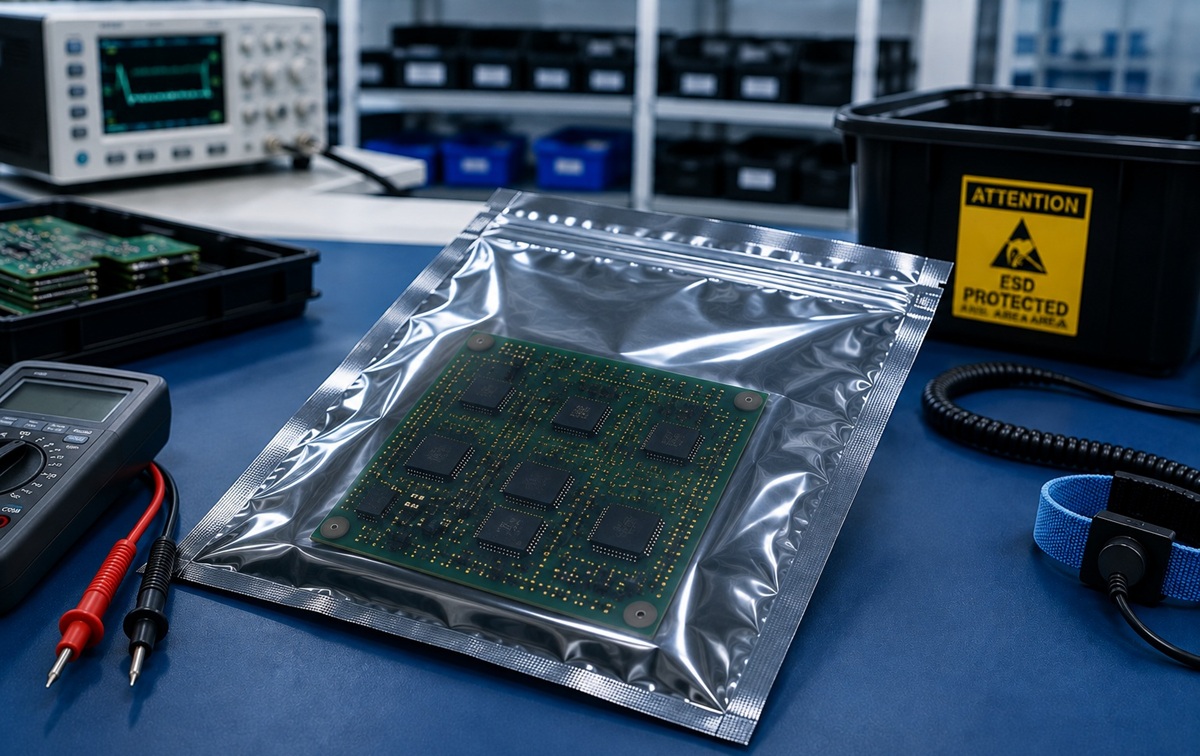
Static shielding bags commonly use multiple material layers because individual layers serve different functions within the finished package.
Pristine Clean Bags® static shielding bags use a four-layer construction that incorporates static dissipative coatings, polyethylene and vacuum-metallized polyester.
Depending on the construction, individual layers can contribute electrical properties, physical protection, flexibility and other performance characteristics.
For a technical buyer, construction should be evaluated alongside the finished bag’s test data. Two products described with the same broad term, such as “static shielding bag,” may use different constructions and may not provide identical performance.
Technical documentation provides a better basis for comparison than the product category alone.
ESD Performance Is Only Part of the Specification
A bag can satisfy electrical requirements yet still be unsuitable if its physical properties do not match the component or workflow.
Consider a sensitive electronic assembly that passes through incoming inspection, production, temporary storage and shipment. The bag may be handled several times before the component reaches its destination.
During that process, packaging can encounter:
- Puncture from component edges
- Stress around seals
- Abrasion
- Repeated flexing
- Pressure from adjacent products during storage or transport
Mechanical performance belongs in the same specification review as electrical performance.
Thickness
Bag thickness influences durability, flexibility, puncture resistance and handling.
The ESD static shielding bags have a typical total thickness of 3.0 mil ±10%, tested according to ASTM D-374.
Thickness should still be evaluated in the context of the component, especially for heavy products or assemblies with sharp edges.
Product geometry, handling frequency, sealing requirements and mechanical risk should guide thickness selection.
Puncture, Tear and Seal Performance
For applications with significant physical handling, engineers may also need to review puncture strength, tear strength, tensile properties, and heat-seal performance.
Typical mechanical test data for these static shielding bags includes ≥12 lb puncture strength and 10 lb/in heat-seal strength, along with the applicable test methods.
These values give technical teams additional information about physical packaging performance and allow mechanical requirements to be evaluated alongside thickness.
A Practical ESD Bag Specification Review
The major requirements can be summarized as follows:
The appropriate combination varies by component and process. A useful technical specification identifies the properties that are critical to the application without carrying unnecessary requirements into every packaging program.
Moisture: When Static Shielding May Not Be Enough
ESD sensitivity and moisture sensitivity are separate packaging concerns.
A static shielding bag should not automatically be assumed to provide the moisture protection required for a moisture-sensitive device.
If a component has moisture exposure limits, the packaging review may also need to address barrier performance, sealing, storage conditions and controls specified by the organization’s handling procedure.
This becomes especially relevant when components remain in storage for extended periods or spend significant time in uncontrolled transportation environments.
Applications with additional moisture-control requirements may require a moisture barrier packaging solution instead of, or in conjunction with, the ESD packaging approach specified by the engineering team.
Cleanroom Applications Add Another Set of Requirements
Electronic components can require both ESD control and contamination control.
For products handled in cleanrooms or other controlled environments, the qualification process should also consider how the packaging is manufactured, handled, documented, and supplied.
Technical teams may review:
- Manufacturing environment
- Packaging cleanliness requirements
- Lot traceability
- Material consistency
- Quality documentation
- Change-control procedures
These controls are particularly relevant in semiconductor, precision electronics, medical electronics, and other processes where packaging enters or supports a controlled manufacturing environment.
Pristine Clean Bags® is ISO 9001:2015 certified. Our quality management system provides a documented framework for process control, traceability, corrective action and continuous improvement.
Example: Specifying a Bag for a Sensitive Electronic Assembly
Consider an electronic assembly that requires ESD protection and moves through several production stages before shipment.
The engineering team first establishes the component’s ESD control requirements and reviews the shielding and surface electrical properties of the proposed packaging.
Physical requirements come next.
If the assembly has protruding leads, sharp corners, or significant weight, puncture and tear performance may require additional attention. Bag dimensions should provide enough room for insertion and sealing without leaving unnecessary material around the assembly.
Storage conditions introduce another consideration. If moisture sensitivity applies, the team needs to determine whether the proposed static shielding construction provides suitable environmental protection or whether a separate moisture barrier solution is required.
Finally, QA can review technical documentation, traceability requirements, and supplier quality controls before the packaging specification is approved.
This sequence connects the ESD requirements with the physical, environmental, and quality requirements of the complete application.
What to Include in an ESD Packaging RFQ
A well-defined request for quotation helps establish both the physical package and the technical requirements behind it.
Where applicable, include:
Component Information
- Product or component type
- Approximate weight
- Dimensions
- Sharp edges, leads, or unusual geometry
Electrical Requirements
- Required ESD protection
- Shielding requirements
- Surface resistance requirements
- Applicable test methods or internal standards
Physical Requirements
- Bag dimensions
- Thickness
- Seal configuration
- Puncture or other mechanical requirements
Environmental Requirements
- Cleanroom use
- Moisture sensitivity
- Storage and transportation conditions
Quality Requirements
- Required documentation
- Lot traceability
- Certificates of conformance where applicable
- Change-control expectations
Commercial Requirements
- Estimated quantity
- Order frequency
- Custom sizing requirements
Providing these details early in the quoting process can reduce specification revisions and help identify potential issues before production.
How to Read an ESD Packaging Data Sheet
Technical data sheets provide useful information during qualification, but the terminology matters.
One important distinction is the difference between typical values and guaranteed product specifications.
Typical values describe representative test results or expected performance. They should not automatically be treated as guaranteed limits for every production lot.
The technical data for Pristine Clean Bags® ESD static shielding bags identifies the reported performance figures as typical values rather than product specifications.
QA and engineering teams should determine:
- Which properties are critical to the application
- Which values are typical
- Which requirements need formal specification limits
- What documentation will verify compliance
- Which test methods apply
This distinction prevents technical data from being converted into acceptance criteria that the data sheet was not intended to establish.
Questions to Resolve Before Approving ESD Packaging
Before final approval, engineering, quality and procurement teams should have clear answers to several questions:
- Does the packaging meet the application’s ESD control requirements?
- Are electrical properties supported by recognized test methods?
- Does the construction provide adequate physical protection?
- Are dimensions and thickness appropriate for the component?
- Are moisture requirements addressed separately where necessary?
- Can technical documentation and traceability be provided?
- How are specification or material changes controlled?
- Can the approved packaging be reproduced consistently?
These questions connect packaging performance with long-term process control.
Common Questions About ESD Bag Specifications
At minimum, provide the required bag dimensions, quantity, ESD protection requirements, and information about the component being packaged. Depending on the application, you may also need to specify thickness, mechanical properties, moisture requirements, cleanroom conditions, documentation and traceability.
Static shielding testing evaluates how much discharge energy reaches the protected side of the packaging under defined test conditions. Lower transmitted energy indicates greater shielding under that specific test method. Results should always be interpreted together with the applicable standard and test conditions.
ESD shielding and moisture barrier performance address different risks. A static shielding bag should not be assumed to provide the moisture protection required for a moisture-sensitive component unless suitable barrier performance has been established for the application.
No, thickness influences physical characteristics such as durability and handling. ESD shielding performance comes from the electrical properties and construction of the packaging. Both factors may need to be reviewed during specification.
Requirements vary by quality system and application. Buyers may request technical data, product specifications, certificates of conformance, lot traceability information and relevant quality documentation.
From Specification to Supplier Quote
A useful ESD bag specification connects the component’s electrical requirements with the physical and operational conditions the package will encounter.
Shielding performance, surface electrical properties, construction, thickness, mechanical strength, dimensions, environmental requirements, and quality documentation all contribute to the final specification.
Pristine Clean Bags® supplies ESD static shielding bags for sensitive electronic components and cleanroom applications. If you have an existing specification or need packaging for a new application, our team can review your requirements and help determine the appropriate size, quantity and packaging configuration.
Contact Pristine Clean Bags® to discuss your application and request a quote.